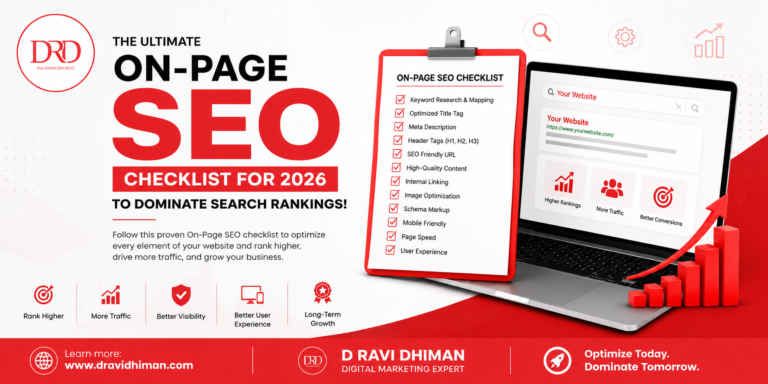
Are you struggling to rank your website on the first page of Google? Because search engine algorithms evolve constantly, you must update your strategies regularly. However, many website owners still ignore the fundamentals. Similarly, they focus entirely on building backlinks while ignoring their own website content. Therefore, you need a bulletproof on-page SEO strategy. Obviously, on-page SEO directly controls how search engines understand your pages. Consequently, ignoring these elements causes poor rankings. As a result, your competitors will steal your organic traffic effortlessly. Indeed, you might possess the best product, yet nobody will find it. Specifically, on-page optimization forms the bedrock of every successful campaign. Thus, you must master these techniques today. Rather than guessing what works, you should follow a proven framework. Ultimately, this ultimate checklist for 2026 will transform your website completely.
Understanding Search Intent and Keyword Research
To start your optimization journey, you must understand exactly what your audience wants. First, you cannot simply stuff keywords into a page anymore. Second, Google now prioritizes search intent above everything else. In short, search intent describes the exact reason why a user types a query. For example, if someone searches for “buy running shoes,” they want to make a purchase. Because of this, you must show them product pages. Consequently, if you show them a long blog post instead, they will leave immediately. As a result, your bounce rate skyrockets. Thus, you must map every primary keyword to the correct stage of the buyer’s journey. Furthermore, you should use secondary keywords naturally throughout your text. Therefore, your content will answer all related questions effortlessly.
Crafting the Perfect Title Tags
Your title tag acts as your first impression in the search results. Because users scan search pages quickly, your title must grab their attention instantly. Therefore, you must write compelling, action-oriented titles. Specifically, you should place your primary keyword as close to the beginning as possible. As a result, search engines recognize the topic immediately. Thus, they rank the page higher. Furthermore, keep your titles under 60 characters. Otherwise, Google will truncate them abruptly. Consequently, users will not see your full message. Instead, they will click on a competitor’s link. Indeed, a well-written title tag drastically improves your click-through rate. Therefore, spend extra time perfecting this single line of text. Surely, you want every possible advantage in the search results.
Writing High-Converting Meta Descriptions
While meta descriptions do not directly boost your rankings, they play a massive role in user behavior. Because they appear directly below your title, they act as a short sales pitch. Therefore, you must use this space wisely. Specifically, write a concise summary that promises immense value. For instance, you can ask a provocative question or state a shocking fact. As a result, users feel compelled to click your link. Thus, your organic traffic increases naturally. Consequently, search engines notice this high engagement. Because of this, they push your rankings even higher. Furthermore, you should include a clear call to action. For example, tell users to “read more,” “discover,” or “learn.” Therefore, you guide their next step explicitly.
Structuring Content with Header Tags
Nobody likes reading a massive wall of text. Because humans have short attention spans, they skim articles before reading them fully. Therefore, you must break your content into digestible sections. Specifically, you should use header tags logically. First, use exactly one H1 tag per page. This tag must contain your main keyword and describe the entire page. Second, use H2 tags to divide your main points. Third, use H3 tags for sub-points. As a result, you create a clear hierarchy. Thus, both users and search engines read through your content effortlessly. Consequently, they understand the context of your article much better. Furthermore, you can include secondary keywords inside your H2 tags. Therefore, you send even stronger relevance signals to Google.
Creating High-Value, Original Content
Content remains the undisputed king of SEO. However, simply writing 500 words no longer works in 2026. Because the internet overflows with generic articles, you must produce something exceptional. Therefore, you must focus on the E-E-A-T framework: Experience, Expertise, Authoritativeness, and Trustworthiness. Specifically, you need to share real-world experiences and unique insights. For instance, rather than copying other blogs, you should conduct your own research. As a result, your content stands out completely. Thus, readers trust your brand. Consequently, they share your articles and link back to your site. Furthermore, you must satisfy the user’s query comprehensively. Because Google tracks how long users stay on your page, you must keep them engaged. Therefore, write deeply researched, highly actionable content every single time.
Optimizing URL Structures
Your URL structure provides another strong signal to search engines. Because long, messy URLs confuse bots, you must keep them short and clean. Therefore, include your primary keyword in the URL string. Specifically, separate words using hyphens rather than underscores. As a result, Google reads the words correctly. Thus, they index your page accurately. Consequently, you avoid any indexing errors. Furthermore, you should remove unnecessary stop words like “and,” “or,” and “the.” For example, instead of “how-to-do-on-page-seo-in-2026,” use “on-page-seo-guide.” Therefore, your URL looks professional and memorable. Indeed, simple changes often yield the biggest rewards. Obviously, a clean URL structure benefits both human users and automated crawlers simultaneously.
Mastering Internal Linking Strategies
Internal links act as the nervous system of your website. Because they connect your pages together, they help search engines understand your site architecture. Therefore, you must link to your most important pages frequently. Specifically, use descriptive anchor text when creating these links. As a result, you pass relevance and authority to the target page. Thus, those pages rank higher for their target terms. Consequently, you distribute your website’s ranking power effectively. Furthermore, internal linking keeps users on your site longer. For instance, if they read an article about SEO, you can link to a related article about keyword research. Therefore, they consume more of your content. Ultimately, this lowers your bounce rate and signals high quality to Google.
Image Optimization and Visual SEO
Visual content makes your pages much more engaging. However, search engines cannot see images like humans do. Because they rely on code, you must describe your images properly. Therefore, you must write descriptive alt text for every single picture. Specifically, explain exactly what the image shows using natural language. As a result, Google understands the context of the visual. Thus, your images can rank in Google Image Search. Consequently, you gain an entirely new source of traffic. Furthermore, you must compress your images before uploading them. Because large image files destroy your page loading speed, you must keep file sizes tiny. Therefore, you protect your Core Web Vitals scores effortlessly. Surely, you do not want an enormous image ruining your rankings.
Enhancing User Engagement Metrics
Google watches how users interact with your website very closely. Because they want to serve the best results, they measure bounce rate, dwell time, and click-through rates. Therefore, you must optimize for human engagement. Specifically, you should hook the reader in the very first paragraph. For example, address their main pain point immediately and promise a clear solution. As a result, they keep reading. Thus, your dwell time increases significantly. Consequently, Google perceives your page as highly relevant. Furthermore, you should use bullet points, bold text, and short paragraphs. Because these elements make reading easier, users consume your content faster. Therefore, you create a frictionless experience from start to finish.
The Importance of Mobile-Friendliness
In 2026, mobile optimization forms a critical part of on-page SEO. Because the vast majority of searches happen on smartphones, you cannot ignore this factor. Therefore, you must make sure your content looks flawless on small screens. Specifically, check your font sizes and button placements. As a result, mobile users browse your site comfortably. Thus, they do not bounce back to the search results. Consequently, you maintain strong engagement metrics across all devices. Furthermore, make sure your pop-ups do not cover the entire screen. Because intrusive interstitials frustrate users, Google actively penalizes sites that use them. Therefore, you must design with a mobile-first mindset always. Obviously, this protects your rankings permanently.
Partnering with the Best Digital Marketing Company in India
Handling all these on-page elements demands constant attention and deep expertise. Because the SEO industry changes rapidly, you might miss critical updates. Therefore, working with the Best Digital Marketing Company in India makes perfect business sense. Specifically, these professionals eat, sleep, and breathe SEO. As a result, they implement strategies flawlessly. Thus, you outrank your toughest competitors. Consequently, your business scales faster than ever before. Furthermore, when you hire the Best Digital Marketing Agency in India, you gain access to an entire team of specialists. Because they handle your content, technical issues, and link building simultaneously, you save enormous amounts of time. Therefore, you can focus on serving your customers. Indeed, investing in a premium Digital Marketing Service in India pays for itself many times over.
Your 2026 Strategy
In the end, on-page SEO gives you total control over your destiny. Because you directly manage your own website, you dictate how search engines view your brand. Therefore, you must execute this checklist meticulously. As a result, your organic traffic will explode. Thus, your revenue will grow predictably. Consequently, your business will dominate the industry. Indeed, many companies still look for shortcuts and hacks. However, search engines penalize those tactics severely. Instead, you must focus on delivering immense value through perfectly optimized content. Therefore, take action today. Review your most important pages, fix the missing elements, and watch your rankings climb to the very top. Surely, your dedication will produce spectacular results.