Google Search is changing rapidly. People no longer search only with short keywords. Instead, they ask detailed questions, compare solutions, look for recommendations, and expect direct answers. At the same time, AI-powered search experiences are changing how information appears on search results pages.
For businesses, this shift creates both an opportunity and a challenge.
A website can no longer depend only on traditional keyword placement. It needs useful information, strong topical relevance, clear structure, technical accessibility, and genuine expertise. Moreover, content should answer the questions people are likely to ask before, during, and after a search.
This is where AI search optimization becomes important.
AI search optimization does not mean creating content only for machines. Rather, it means improving a website so that search engines and AI-powered search systems can understand its subject, context, expertise, and usefulness more effectively.
Google’s current guidance confirms that established SEO practices remain relevant for generative AI search experiences because these systems rely on Google’s existing ranking and quality systems.
Therefore, businesses that combine technical SEO with helpful, original, and well-structured content can build stronger visibility across traditional search and emerging AI-driven experiences.
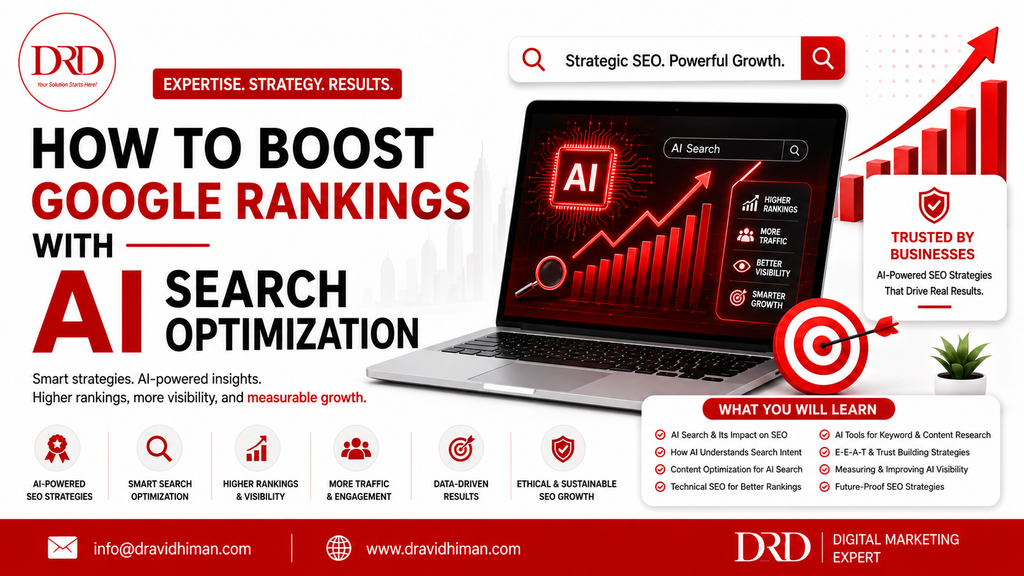
What Is AI Search Optimization?
AI search optimization is the process of preparing website content and technical elements so search engines and AI-powered search experiences can understand, evaluate, and potentially surface that information for relevant searches.
Traditional SEO often focuses on ranking pages for specific search queries. AI search optimization takes a broader approach.
It considers:
- Search intent
- Topic relevance
- Entity relationships
- Natural-language questions
- Content depth
- Website structure
- First-hand experience
- Trust signals
- Technical accessibility
- Internal linking
- Structured data where appropriate
- Helpful and original information
For example, a business may traditionally target a keyword such as “digital marketing company in Chandigarh.” However, modern users may ask:
- Which digital marketing company is suitable for a small business?
- What services should a digital marketing agency provide?
- How much does SEO cost in Chandigarh?
- How can a local business improve Google visibility?
- What is the difference between traditional SEO and AI search optimization?
A strong strategy considers the entire topic instead of focusing on one exact phrase.
Why AI Search Optimization Matters for Google Rankings
Search engines aim to provide useful results that satisfy user needs. As search becomes more conversational, websites need to provide information that can answer broader and more complex queries.
AI-powered search experiences can examine information from multiple pages and connect related concepts. Consequently, a website with clear topical coverage can create more opportunities to appear for relevant searches.
However, AI optimization should not replace SEO.
Google’s official documentation states that SEO best practices continue to apply to generative AI features in Search. It also recommends maintaining technically sound websites and creating unique, useful content for people.
This means businesses should focus on the fundamentals first.
A strong foundation includes:
- Crawlable website architecture
- Indexable pages
- Useful and original content
- Clear search intent
- Strong internal linking
- Relevant entities and topics
- Good page experience
- Credible information
- Helpful multimedia
- Continuous performance monitoring
Together, these elements create a website that works for both users and modern search systems.
1. Understand Search Intent Before Creating Content
Search intent should remain at the center of every SEO strategy.
Before creating a page, businesses should determine what the searcher actually wants.
Search intent commonly falls into categories such as:
Informational Intent
The user wants to learn something.
Examples include:
- What is AI SEO?
- How does Google ranking work?
- How can a business improve organic traffic?
Commercial Investigation
The user is researching options before making a decision.
Examples include:
- Best SEO agency in Chandigarh
- AI SEO services comparison
- Digital marketing agency pricing
Transactional Intent
The user is ready to take action.
Examples include:
- Hire SEO experts
- Book digital marketing consultation
- Request SEO services
Navigational Intent
The user wants to find a particular website, company, or resource.
Understanding these differences allows businesses to create pages that genuinely answer user needs.
2. Build Topic Clusters Instead of Writing About One Keyword
Modern SEO works better when a website demonstrates knowledge across an entire subject.
For instance, a business targeting AI SEO can create supporting content around:
- AI search optimization
- Generative search
- Google AI Overviews
- Search intent
- Semantic SEO
- Technical SEO
- Content optimization
- Entity SEO
- Structured data
- Internal linking
- Content quality
- Local SEO
- Search performance measurement
These topics can connect through internal links.
As a result, search engines can better understand how different pages relate to the central subject.
This approach also helps visitors move naturally from one piece of information to another.
3. Create Helpful, Original, and Experience-Based Content
AI tools can generate content quickly. However, speed alone does not create authority.
A website needs information that provides genuine value.
For example, instead of publishing a generic article about SEO, a company can include:
- Real campaign observations
- Industry-specific examples
- Original research
- Practical recommendations
- Expert commentary
- Case-study insights
- Data analysis
- Common mistakes
- Step-by-step processes
- Frequently asked questions
This type of information gives readers something they cannot easily find across hundreds of similar pages.
Google’s spam policies specifically warn against scaled content abuse, including producing large volumes of unoriginal content primarily to manipulate rankings. The issue applies regardless of whether the content comes from generative AI or another method.
Therefore, AI should support content production rather than replace expertise and editorial judgment.
4. Improve Content for Natural-Language Questions
People increasingly use conversational searches.
Instead of searching:
a user might search:
“How can a business in Chandigarh optimize its website for AI-powered Google search?”
This difference matters.
Content should therefore include natural questions and direct answers.
Useful question formats include:
- What is AI search optimization?
- Why is AI search important for SEO?
- How does AI affect Google rankings?
- How can businesses optimize content for AI search?
- Does technical SEO still matter?
- How can companies measure AI-search visibility?
Answering these questions clearly improves topical coverage.
It also makes content easier for users to scan.
5. Use Semantic SEO to Build Context
Semantic SEO focuses on meaning and relationships between concepts rather than repeatedly using an exact keyword.
For example, an article about AI SEO may naturally discuss:
AI search → Google Search → AI Overviews → search intent → entities → topical authority → technical SEO → content quality → user experience
These concepts support one another.
Therefore, a page becomes more comprehensive without repeatedly inserting the same phrase.
Businesses can strengthen semantic relevance by covering:
- Related terms
- Synonyms
- Subtopics
- Entities
- Questions
- Attributes
- Processes
- Use cases
- Industry examples
This approach creates content that reads naturally while giving search engines more context.
6. Strengthen Technical SEO
High-quality content cannot perform well if search engines cannot properly access or understand a website.
Technical SEO should therefore remain a core part of AI search optimization.
Important areas include:
Crawlability
Search engines should be able to discover important pages.
Indexability
Relevant pages should remain eligible for indexing.
Site Architecture
Important information should not remain buried several clicks deep.
Mobile Experience
Pages should work effectively across mobile devices.
Page Performance
Fast and stable pages can provide a better experience for visitors.
Internal Linking
Relevant pages should connect logically.
Canonicalization
Duplicate or similar URLs should be managed appropriately.
XML Sitemap
A well-maintained sitemap can help search engines discover important URLs.
Google’s AI-search guidance emphasizes crawlability, indexability, clear technical structure, semantic HTML, and good page experience.
7. Optimize Website Structure for People and Search Engines
A clear content structure makes information easier to understand.
A well-organized page should normally include:
- One clear H1
- Descriptive H2 headings
- Supporting H3 headings
- Short paragraphs
- Bullet points
- Relevant examples
- Descriptive links
- Useful images
- Clear calls to action
Moreover, each section should answer a specific question or explain a distinct idea.
This structure helps visitors scan the page quickly.
At the same time, it gives search systems a clearer understanding of the relationship between different sections.
8. Use Structured Data Correctly
Structured data can help search engines understand certain types of information on a page.
Depending on the website, appropriate schema types may include:
- Organization
- LocalBusiness
- Article
- BreadcrumbList
- Product
- Service
- Event
- Review-related markup where eligible
However, businesses should avoid treating schema as an AI-ranking shortcut.
Google’s current AI optimization guidance makes clear that special schema or dedicated AI markup is not required simply to appear in generative AI search features. Standard SEO remains the priority.
Therefore, structured data should accurately describe visible page content and support an overall SEO strategy.
9. Build Strong E-E-A-T Signals
E-E-A-T stands for:
Experience, Expertise, Authoritativeness, and Trustworthiness.
These principles matter because searchers need reliable information.
Businesses can demonstrate these qualities by providing:
Real Experience
Show practical experience, examples, project insights, or original observations.
Expertise
Explain complex topics accurately and clearly.
Authority
Build recognition through credible references, mentions, links, and industry contributions.
Trust
Provide transparent company information, contact details, author information, policies, and accurate claims.
For service businesses, trust can also come from genuine testimonials, project examples, case studies, and clearly explained processes.
The goal is not to add E-E-A-T phrases mechanically. Instead, the website should demonstrate credibility through its actual content and business information.
10. Optimize for Local Search
Local businesses need a strong geographic relevance strategy.
For example, a company targeting Chandigarh can create useful local content around:
- SEO services in Chandigarh
- Digital marketing for Chandigarh businesses
- Local SEO strategies
- Chandigarh business trends
- Industry-specific marketing solutions
- Local customer behavior
However, simply repeating “Chandigarh” throughout every paragraph does not create local authority.
Instead, the content should provide useful local context.
A business seeking AI SEO Services in Chandigarh can benefit from a strategy that combines local SEO, service pages, educational content, Google Business Profile optimization, reviews, citations, and location-relevant information.
11. Create Content That Answers Follow-Up Questions
One major advantage of AI-powered search is its ability to explore a topic through multiple related questions.
Therefore, content should anticipate what readers may ask next.
For example:
Primary question:
What is AI search optimization?
Follow-up questions:
How does it affect SEO?
Does traditional SEO still work?
How should content be structured?
Does AI-generated content rank?
What technical factors matter?
How can businesses measure results?
A comprehensive article can answer these questions within relevant sections.
Consequently, users may find the page more useful because it reduces the need to search elsewhere.
12. Focus on Original Data and First-Hand Insights
Generic information exists everywhere.
Original information creates differentiation.
Businesses can strengthen their content by publishing:
- Industry statistics
- Customer research
- Survey results
- Original case studies
- Before-and-after performance data
- Expert interviews
- Campaign observations
- Testing results
- Unique frameworks
For example, an SEO agency could publish an anonymized case study explaining how technical improvements, content restructuring, and internal linking affected organic visibility.
Such content demonstrates experience instead of simply claiming expertise.
13. Optimize Images, Videos, and Other Media
AI-driven search is not limited to plain text.
Visual and multimedia content can support the overall search experience.
Businesses should consider:
- Descriptive image filenames
- Useful alt text
- High-quality original images
- Relevant video content
- Captions and transcripts
- Infographics
- Screenshots
- Charts
- Demonstrations
Most importantly, media should add information.
A decorative image alone contributes little. However, an original infographic explaining a complex SEO process can improve understanding and engagement.
14. Strengthen Internal Linking
Internal links help users discover related information.
They also help search engines understand website relationships.
For example, an article about AI search optimization can link naturally to pages covering:
- Technical SEO
- Local SEO
- Content marketing
- Keyword research
- SEO audits
- Digital marketing
- Conversion optimization
The anchor text should describe the destination accurately.
Furthermore, important commercial pages should receive relevant internal links from useful informational content.
15. Avoid AI Content Without Human Review
AI can help with:
- Research organization
- Content outlines
- Topic discovery
- Drafting
- Editing
- Summarization
- Content gap analysis
- Data organization
However, publishing large amounts of unedited AI content can create quality problems.
Common issues include:
- Repetitive explanations
- Incorrect facts
- Generic examples
- Missing context
- Unsupported claims
- Awkward language
- Search-intent mismatch
- Lack of original insight
Therefore, human review remains essential.
The strongest workflow combines AI efficiency with human expertise, fact-checking, editing, and real-world experience.
16. Measure More Than Traditional Rankings
AI search optimization requires a broader measurement approach.
Businesses should monitor:
- Organic impressions
- Organic clicks
- Keyword rankings
- Search visibility
- Click-through rate
- Organic conversions
- Engagement
- Branded searches
- Local visibility
- Indexed pages
- Crawl issues
- Top-performing content
- Content-assisted conversions
Google also provides Search Console reporting for search performance, including how AI features are represented within Search reporting.
However, businesses should not judge success through one ranking position alone.
A page that attracts fewer clicks but reaches highly relevant users may produce more business value than a high-volume keyword with weak commercial intent.
17. Choose the Right SEO and Digital Marketing Partner
AI search optimization requires a combination of strategy, technical knowledge, content expertise, analytics, and continuous testing.
Businesses should evaluate an agency based on:
- Proven experience
- Transparent reporting
- Technical SEO knowledge
- Content expertise
- Local SEO capabilities
- Understanding of AI search
- Ethical SEO practices
- Clear communication
- Relevant case studies
- Measurable objectives
For businesses looking for a Best SEO Company in Chandigarh, the focus should remain on proven capabilities rather than marketing claims alone.
Likewise, companies searching for Best Digital Marketing Services in India should evaluate whether an agency understands the complete digital journey, from search visibility to traffic, leads, conversions, and customer retention.
A strong agency should not promise guaranteed Google rankings. Instead, it should explain the strategy, expected outcomes, risks, measurement process, and timeline realistically.
18. How AI Search Optimization Can Help Different Businesses
AI search optimization can support businesses across many industries.
E-commerce Businesses
Product information, comparisons, category pages, reviews, and useful buying guides can help customers make informed decisions.
Local Businesses
Location-specific service pages, local content, reviews, and accurate business information can strengthen local visibility.
Professional Services
Detailed service pages, expert articles, case studies, and author information can demonstrate credibility.
B2B Companies
Research-driven articles, technical guides, comparisons, and original insights can help attract decision-makers.
Startups
Educational content can help new brands establish topical relevance and answer common customer questions.
AI Search Optimization vs Traditional SEO
Traditional SEO and AI search optimization should not be treated as competing strategies.
They work together.
| Traditional SEO | AI Search Optimization |
|---|---|
| Targets search queries | Addresses broader user journeys |
| Focuses on keywords | Focuses on topics and meaning |
| Optimizes pages | Optimizes the complete information experience |
| Builds rankings | Builds visibility across search experiences |
| Uses technical SEO | Continues using technical SEO |
| Targets search intent | Expands into conversational questions |
| Uses content | Prioritizes useful, original content |
The important point is simple: AI search does not eliminate SEO.
Instead, it expands the way businesses should think about search visibility.
Common AI SEO Mistakes Businesses Should Avoid
Keyword Stuffing
Repeating the same keyword unnecessarily can make content difficult to read.
Publishing Generic AI Articles
Large volumes of similar content rarely create meaningful differentiation.
Ignoring Technical SEO
Excellent writing cannot compensate for serious crawling or indexing problems.
Creating Content Without Search Intent
A page can be well written and still fail if it does not answer the user’s actual need.
Using Unsupported Claims
Statistics, guarantees, and industry claims should have a credible basis.
Ignoring Existing Content
Sometimes updating a valuable existing page creates more value than publishing another new article.
Chasing Every AI Trend
Businesses should prioritize proven SEO practices rather than every new optimization trick.
Google’s current guidance specifically cautions against focusing on supposed AEO/GEO hacks instead of effective SEO fundamentals.
Practical AI Search Optimization Checklist
Before publishing a page, a business can review the following checklist:
- Is the search intent clear?
- Does the page answer the primary question?
- Does it address important follow-up questions?
- Is the information original or meaningfully improved?
- Does the page demonstrate relevant expertise?
- Are important claims accurate?
- Is the content easy to scan?
- Are headings logically structured?
- Are internal links relevant?
- Can search engines crawl the page?
- Can the page be indexed?
- Is the mobile experience strong?
- Are images useful and optimized?
- Is structured data accurate where applicable?
- Does the page provide something beyond generic information?
- Does it help the reader take the next step?
If the answer is yes across most of these areas, the page has a stronger foundation for modern search.
The Role of a Digital Marketing Agency in AI Search
AI search optimization involves more than content writing.
It can require:
- SEO audits
- Keyword research
- Competitor analysis
- Content strategy
- Technical SEO
- Local SEO
- Content optimization
- Digital PR
- Analytics
- Conversion optimization
- Continuous testing
Therefore, companies may choose to work with an experienced agency rather than managing every activity internally.
When selecting a Best Digital Marketing Company in Chandigarh, businesses should look for a team that understands both traditional search and the evolving AI-driven search environment.
The right partner should focus on sustainable growth rather than short-term ranking tricks.
Future of Google Rankings in the AI Search Era
Search will continue to evolve.
Users may increasingly interact with search through conversational queries, AI-generated answers, multimodal experiences, and personalized discovery.
However, one principle is unlikely to change: people need useful information.
Websites that provide accurate, original, accessible, and trustworthy content can remain valuable as search interfaces change.
Google’s latest documentation also reinforces this direction. Its guidance for generative AI search emphasizes technical SEO, unique helpful content, and established SEO practices rather than special AI-only shortcuts.
Consequently, businesses should build websites that serve people first while ensuring search engines can understand and access the information.
Now Take This Serious
AI search optimization is not about finding a secret formula for Google rankings.
Instead, it is about adapting established SEO principles to a search environment where users ask more detailed questions and search engines increasingly synthesize information.
A successful strategy combines:
Technical SEO + Search Intent + Semantic SEO + Original Content + E-E-A-T + Local Relevance + Internal Linking + User Experience + Continuous Measurement
Businesses that follow this approach can create a stronger digital presence without relying on keyword stuffing or low-value automated content.
Whether a company works with a Best SEO Company in Chandigarh, invests in AI SEO Services in Chandigarh, explores Best Digital Marketing Services in India, or partners with a Best Digital Marketing Company in Chandigarh, the core objective should remain the same: create useful digital experiences that genuinely help people.
The future of search belongs less to websites that simply contain keywords and more to websites that provide clear answers, demonstrate real expertise, and deliver trustworthy value.
Frequently Asked Questions
What is AI search optimization?
AI search optimization is the process of improving a website’s content, structure, technical accessibility, and topical relevance so it can perform effectively across traditional and AI-powered search experiences.
Does AI search optimization replace traditional SEO?
No. Google states that SEO best practices continue to be relevant for generative AI features in Search because those features rely on Google’s existing ranking and quality systems.
Can AI-generated content rank on Google?
AI-assisted content can appear in Search when it provides value and follows Google’s policies. However, producing large volumes of unoriginal content primarily to manipulate rankings can fall under Google’s scaled content abuse policy.
Is special AI markup required for Google AI search?
No. Google’s current guidance says websites do not need special AI-only markup or an llms.txt file to appear in generative AI search features. Standard SEO practices remain important.
How can a business improve its AI search visibility?
A business can focus on crawlability, indexability, useful original content, clear website architecture, search intent, topical coverage, internal linking, trustworthy information, and strong user experience.
Does E-E-A-T matter for AI search optimization?
Businesses should demonstrate experience, expertise, authority, and trust through accurate information, transparent authorship, original insights, credible evidence, and genuine business information.
How long does AI search optimization take?
Results vary by website, industry, competition, content quality, technical condition, and search demand. SEO should be treated as a continuous process rather than a one-time activity.